

2026 TV Laurel Award Honoree Don Reo reflects on his career.
2/21/2025 • Evan Henerson
Writers Guild Awards : Voices of Victory
Enjoy post-show reactions, photos, and video from 2025 Writers Guild Awards.


2026 TV Laurel Award Honoree Don Reo reflects on his career.
Don Reo has always been quick with a quip, from the time he got his first laugh sometime back in junior high school to the jokes he wrote for traveling comedians, through the half century he spent “pushing the limits” of sitcoms to the book he is currently negotiating with Random House—The Tibetan Joke Book of the Dead.
“It’s about Hollywood and death which are probably synonyms,” said Reo, the recipient of WGAW’s Paddy Chayefsky Laurel Award for Television Writing Achievement to be presented at the 2026 Writers Guild Awards. “I think you’re born with a funny gene, or maybe it’s the way you’re raised. Nobody else in my family was particularly funny, but I got a laugh in the seventh grade, and I thought, ‘Maybe I can do this. This is nice because it stops people from hitting you.’ I read that Woody Allen was making $500 a week writing jokes, and I thought, ‘Well, fuck, I can do that!’”
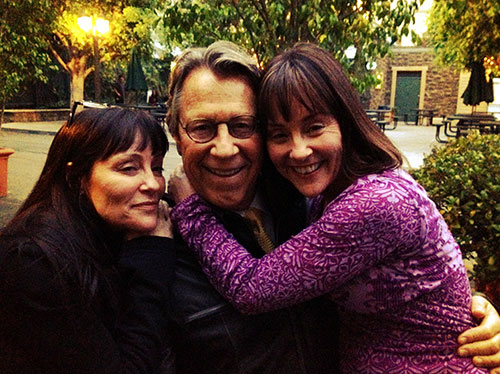 Don Reo with Double Trouble stars Jean and Liz Sagal.
And he did, effectively launching a career that has spanned seven decades, earning writing credits on series such as Sanford and Son, Rowan & Martin’s Laugh-In, M*A*S*H, and Rhoda and creating or co-creating Blossom, My Wife and Kids, The John Larroquette Show, and The Ranch.
“I started working in television in 1969, and I was never out of work for 50 straight years,” Reo said. “Then I retired from television, and I pretty much forgot about it except for the friends that I had accumulated along the way. In conversation, somebody might mention Cher or Blossom and it would trigger all these memories that I have of the various shows, but most of them time I don’t think about it at all.”
During an interview with Written by, Reo shared several memories as he reflected on his years in the industry, the friends he has made, and the stories he has brought to the screen. A practiced storyteller and a wit, Reo thought he was the one being played when WGAW Board member Matt Ross informed him of the TV Laurel Award selection.
“I had to pause for a second because Matt occasionally fucks with me,” Reo said. “I said, ‘Matty, are you fucking with me?’” Reo said. “And he said, ‘No, no, everybody in the room loved you, and we think you’re deserving of the award.’ I was chuffed as they say in England. Very happy, and I still am.”
In addition to his comedic skills, Reo says he benefitted early from the ability to envision a story in pictures inside his head. He discovered this skill after taking on a ninth grade creative writing assignment in which the class was asked to imagine being a member of a family of pilgrims the night before they departed for the new world.
After reading his entry, the teacher announced “We have a writer in the room,” and read the paper aloud to generous applause.
“I saw the whole thing. Pictures appeared in my head. I just had to write down what I was seeing,” he said. “That was clearly a turning point when I discovered the visual part of writing. I don’t know how any other writers do it, but I see movies. I see pictures, and I just write down what the pictures are. The more I did it, the clearer the pictures became.”
After high school, while working at his father’s furniture store in Kingston, Rhode Island, Reo started selling jokes to comedians who came through town including Jackie Mason and Kay Ballard. After seeing actor-comedian Slappy White toss out a series of one-liners during an appearance on The Tonight Show, Reo went to see White perform at a nearby club. After the performance, Reo showed the comedian his jokes. White hired Reo—then 19 years old—to go on the road with him and feed him lines.
The pay was $300 per week plus expenses, which topped the $150 he was earning delivering furniture.
“He said, ‘We open at the Apollo Theater next Friday night with Jackie Wilson and Big Maybelle,’” said Reo. “So I went home that night and the next morning, I told my parents I was leaving town with a 52-year-old Black guy named Slappy. We worked the act for a couple of days. Then on Friday night, I put on a tuxedo and I walked out on stage at the Apollo and I introduced him, and for the next two and a half years, we were on the road together touring America.”
 “For every compliment I ever have received or will receive in my life, I owe thanks to Don Reo for his heart, his mind, and his pen; all of which are mighty, beautiful, and mind-bendingly profound” – Mayim Bialik
Reo eventually made his way to California, looking to work in TV. He called the offices of Bernie Kukoff and Jeff Harris at a moment when the producers were looking for a young joke writer for Jimmy Durante Presents the Lennon Sisters. During his year on the variety series, Reo found himself meeting with “every luminary in show business and some lesser lights.” Reo went from Durante to Laugh-In where he met writing partner Allan Katz.
“We got the opportunity to write half-hours,” he said. “In those days, there was a much bigger distinction between being a joke writer and a half-hour writer. That was a much higher art form.”
With Katz, Reo wrote seven episodes of Sanford and Son, followed by freelance episodes of All in the Family, The Mary Tyler Moore Show and several variety specials, including The Jackie Gleason Special. Working solo again, Reo wrote and produced The Cher Show, the variety show hosted by Cher after her split with Sonny Bono.
Reo’s first foray into producing his own work was the swords and sorcery-themed Wizards and Warriors. In 1990, he hit with Blossom, a family comedy starring a young Mayim Bialik. Reo took his inspiration from a visit to the Florida home of singer Dion DiMucci of Dion and the Belmonts. Sitting around the DiMucci breakfast table, Reo took stock what seemed like a perfectly conventional family of five whose father happened to be in the Rock and Roll Hall of Fame.
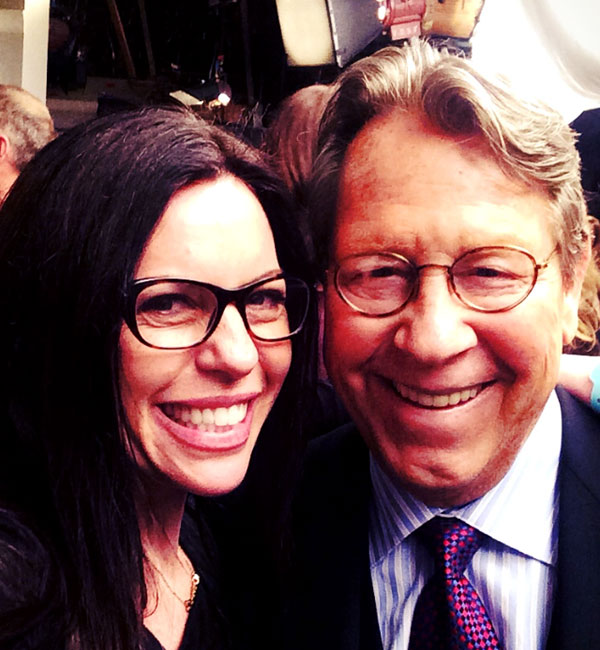 Don Reo with fellow Two and a Half Men writer Susan McMartin.
“I was always pushing against the limitations of the sitcom form,” Reo said. “All the dads on TV at the time were like my dad. There were no dads who were like me, and certainly no dads like Dion. So, the original idea was to do a show about a dad who was a pianist for The Tonight Show band, and he had these three kids who he was raising by himself because his wife had left the family to pursue a singing career in Chicago. I wanted to focus on the middle boy because I thought there’s an opportunity to do Catcher in the Rye as a sitcom.”
The network had other ideas, insisting on a nuclear family and suggesting that the series focus instead on the daughter. Reo already had a name for the character: Blossom, in honor of singer Blossom Dearie.
“I thought, wow this is a great idea because I can steal all the Wonder Years stories and no one will know,” Reo said. “So Blossom became the center of the show, and I’m doing Catcher in the Rye with a nuclear family, and we made the pilot, and it didn’t work. And [NBC Entertainment Division President] Brandon Tartikoff said to me, ‘You were right. Let’s go back and do it with the single dad the way you originally pitched it.’”
Which Reo did, with one small but critical change to his original script. Instead of having Blossom’s mother leave the family to chase her dreams in the Windy City, Reo crossed out “Chicago” and wrote “Paris,” figuring production might benefit if the show proved successful.
“Four years later, we got to spend six weeks at the Ritz Hotel in Paris when we shot a bunch of episodes there,” Reo said. “Just the one word changed. Fantastic!”
Having known Reo since she was a teenager, series star Mayim Bialik, who will present the TV Laurel to Reo at the ceremony, refers to him as “my third parent.”
“For every compliment I ever have received or will receive in my life, I owe thanks to Don Reo for his heart, his mind, and his pen; all of which are mighty, beautiful, and mind-bendingly profound,” Bialik said.
Although he says his showrunning days are in the past, Reo continues to seek the camaraderie of a room full of writers. “I have a group of writer friends and we have replicated a writers’ room. We meet once a week, smoke cigars, and shoot the shit, but it’s more than that. We’re in the room.”
Already the author with E Street Band saxophonist Clarence Clemons of the book Big Man, Reo has often been pressed to write his own memoirs. He said he tried once, but lost interest.
“I got busy with something else. Something real came along and, you know how it is,” he said. “They’re like love affairs…our storytelling, our shows, our books. Some last and some burn brightly and then go out.”
2/21/2025 • Evan Henerson
Enjoy post-show reactions, photos, and video from 2025 Writers Guild Awards.