
Writers mobilize against the Paramount Skydance/Warner Bros. Discover merger.
9/9/2026 • Evan Henerson
How to Put Words in Conan’s Mouth
Awards show writers share craft advice and tips for members looking to break into the genre.
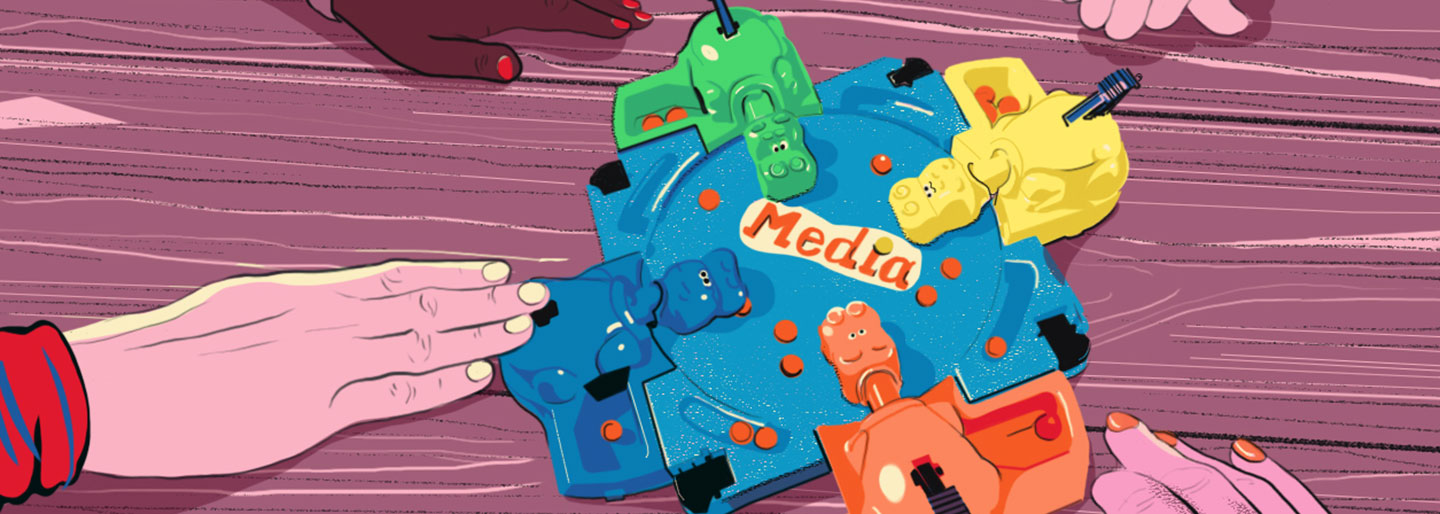
Writers mobilize against the Paramount Skydance/Warner Bros. Discover merger.
The proposed $110 billion Paramount Skydance/Warner Bros. Discovery merger has writers and antitrust watchers concerned.
Paramount Skydance CEO David Ellison has claimed that the merger will result in more theatrical releases (30 a year between Paramount and Warner Bros.), but the Guild has long noted the sobering reality: previous mergers have produced the opposite, with writers and independent producers losing ground creatively and financially. The 2019 Disney-Fox merger led to fewer movies being produced; following the Warner Bros.-Discovery merger, numerous BIPOC writer-led projects were canceled and other programming pulled.
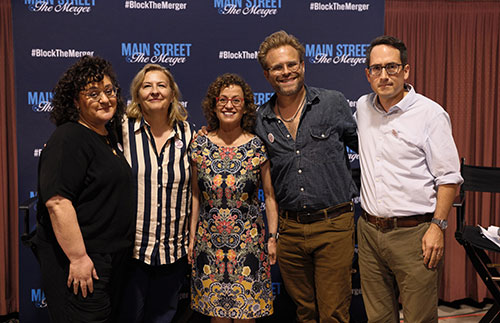 Documentary filmmaker Marjan Safinia [L-R], WGAW President Michele Mulroney, FCC Commissioner Anna M. Gomez, WGAW Board member Adam Conover, and former FTC Commissioner Alvaro Bedoya at the Main Street vs. The Merger event on June 6. Photo by Meeno Peluce.
To bring attention to the crisis, an impassioned crowd of WGAW members and other industry workers recently packed the Lumiere Music Hall theater in Beverly Hills for Main Street vs. The Merger. The event was one of three nationwide roundtables organized by the Writers Guild of America, The American Economic Liberties Project, the Future of Film Coalition, The Committee for the First Amendment, Democracy Defenders Action and Free Press to give those affected by such mergers—writers, costumers, makeup artists, caterers, independent theater owners, and more—a platform to air their concerns about the danger consolidation poses.
AELP senior advisor and former Commissioner of the Federal Trade Commission Alvaro Bedoya led the panel, comprised of Writers Guild of America West President Michele Mulroney; WGAW Board member Adam Conover; Commissioner Anna Gomez, from the Federal Communications Commission; and documentary filmmaker Marjan Safinia.
“A combined Warner Brothers and Paramount would create a media behemoth with tremendous leverage to reduce content, raise prices, increase control of production, suppress writer compensation, worsen working conditions, and silence the voices of our members,” Mulroney told the audience. “It’s our view that these companies should be focused instead on investing that money in their own businesses, rather than wasting tens of billions to buy up the competition.”
Mulroney went on to describe the combination of industry contraction and consolidation as “a lethal, one-two punch we can’t allow.” When economic and political powers combine, leaving only a handful of studios controlling the market, a threat to democracy can emerge, she added. Conover, whose Adam Ruins Everything truTV comedy series was cancelled following AT&T’s 2018 acquisition of Time Warner, suggested that Hollywood’s survival also depends on individuals speaking out rather than worrying about damage to their careers.

It’s our view that these companies should be focused instead on investing that money in their own businesses, rather than wasting tens of billions to buy up the competition.
- Michele Mulroney
“Writers, actors, directors would come here to ply their trade, sell something into an open market, sell an idea, then employ hundreds and thousands of people underneath them,” he said. “That created the media ecosystem that caused America to be a cultural power in the world, and created all the wonderful media that we love. And it’s about to die.”
For Commissioner Gomez, an alarm bell is ringing over limitation to content. “Our country is great because we encourage a diversity of viewpoints,” she said. “When we see all of this consolidation, when we see an administration that does not tolerate any kind of dissent, we are losing that.”
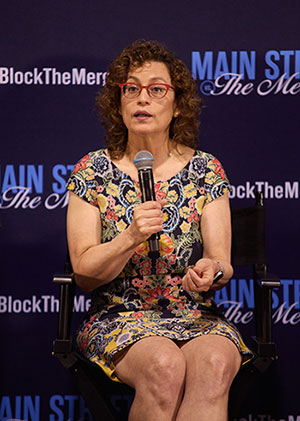 FCC Commissioner Anna M. Gomez speaks at the Main Street vs. The Merger event at the Lumiere Music Hall theater in Beverly Hills. Photo by Meeno Peluce.
Safinia warned that with waves of consolidation already “strangling” documentarians, and with CNN and its 45-year news archive folded into the merger, “poorly told versions of history could fall under editorial control.”
“The public airwaves belong to every American, not just billionaire buddies of this administration and the foreign governments that fund them,” said Bedoya.
The audience also spoke out to tell of diminished careers, dashed business dreams, and thwarted ideas—circumstances likely to spread in the face of yet another merger.
“A market that’s already been shrinking for economic reasons is going to be shrinking even further for ideological ones,” said attorney Robyn Aronson, former head of Business and Legal Affairs for Netflix Original Documentaries.
As a young, diverse, underrepresented writer 10 years ago, WGAW Board member Danny Tolli explained, he was able to sell shows because there were so many buyers. “Cut to just last year. I had a project with CBS Studios, and we could only take it to three places.” He has had to start looking outside traditional TV writing, he said. “Everyone is struggling, and I truly believe that my story is very common.”
A comedy writer and WGAW member, Andra Whipple, who lost her job when Conover’s Adam Ruins Everything was canceled, sent a message to viewers: “This is going to screw you over, too,” she said. “If this merger moves forward, you will laugh less. You will have less great TV shows and movies to bond with your grandma and your weird coworkers over. You’re rewatching Friends and The Office over and over again, not because we stopped having funny ideas, but because those classic meat and potato shows do not live in a landscape without competition.”