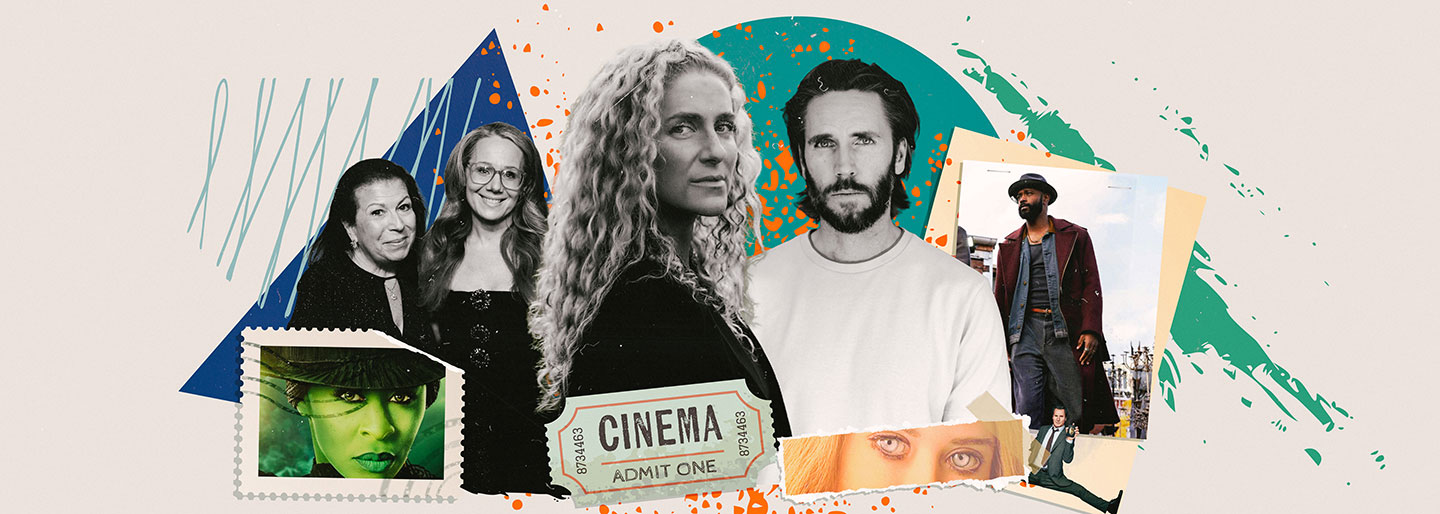
Whenever they drop by the 3rd & Fairfax podcast, WGAW writers are always generous with their anecdotes, insights and pearls of wisdom. After hearing from several of our recent showrunner guests, Written by cocked an ear to receive some bits of choice advice from some of our screenwriters. Check out the full episodes below and visit our YouTube channel to hear more.
Take the General – Kate Gerstin (The Last Showgirl)
“Have a good attitude about general meetings. You never know where they’re going to lead. I had a general with someone at Amazon that led to my first job on Mozart in the Jungle. I think the generals can be hard for a lot of writers because it’s hard for us to talk about ourselves sometimes. Some of us are good at it, and some of us are not so good at it. I think just having a positive attitude about general meetings is one little tiny piece of advice that I would say is a good thing to cultivate.”
Conquering Fear – Gerard Johnstone (M3GAN 2.0)
“Fear is antithetical to creativity, and that fear freezes you. I’m not going to give these people the satisfaction of stopping me in my tracks where I am. I’m going to get through this. I'm going to figure out a way forward, and I’m just not going to give a shit. I just have to follow my gut and my instincts and the fun. I have to find the fun in this. A lot of people get really stressed out in this business about the financial side, is the movie going to do well, is it going to perform, are people going to like this? When you let fear run everything, nothing good happens. I always try to be mindful of that.”
Writing for a Specific Actor…or Not – Shane Black (Play Dirty)
“When I read a novel, there’s a character I picture. It’s not an actor or an actress. It’s sort of an amalgam of various things in my life…but it’s not one face assigned to a performer that I’m hoping to then hire. When I write, I just picture something. In that regard it’s good because you can take an actor and they will sort of gradually shift as they enter the role, and they will acquire the character hopefully with you as you work, but then maybe when you think of that character, you start to picture the actor, but they have to show up and move into the character. We’re not moving the character into an actor. For the first draft, it’s never about a performer, it’s about the performer coming to meet the character.”
Creating the Mosaic – Anthony Bagarozzi (Play Dirty)
“Each scene is just a little gem in that larger mosaic. You take each one, and you polish it up and you make it perfect and you put it in, and you put the next ones in, and they’re all great, but you’ve got to step back and look at them all and say, ‘Does it form the picture of the mosaic?’ Everything is interconnected in that way. You can’t just write good scenes, and you can’t just write a good story. You have to be able to mix those in a way that provides an interesting final product.”
Pitching and Writers Block – Bill Condon (Kiss of the Spider Woman)
“I never (pitch) until I feel like I’ve answered all the basic questions. Feeling confident that you’ve worked out what you want it to be. And sometimes that can take a very long time.
I think the reminder that all of those days of torture, during those days, writing is happening. Being able to say, if you’re feeling down, ‘This will have an end. There will be another side to this,’ and just embracing it. And letting a day, two days, a week, two weeks of not producing, giving that its own value as long as you’re still there trying.”
Messes are OK – Winnie Holzman (Wicked: For Good)
“Nothing takes the place of the writing. Nothing teaches us writing. It’s really easy to fall into a feeling that you can’t do it or that you just can’t bear to do it. I have little tricks that help me. Just reminding myself that I can write a really bad version of just one scene, and then that can be writing. As long as I have something that I can start to make better. In the end, there has to be a willingness to make a fool of yourself, to have a really bad draft and maybe more than one really bad draft, bad ideas, things that go nowhere. You just have to make a big mess. It doesn’t come out of your pen or your hands on the computer looking all good. Just keep asking yourself the same basic, really important questions of, ‘Who is my main character again? What does she want? Why is she not getting it? What's going to happen if she makes this decision? What’s then going to come from that decision?’ It’s always the basics.”
Loving the Notes, Structuring the Pitch – Dana Fox (Wicked: For Good)
“Notes are good. They mean you still have a job. The only time they stop giving you notes is when you're fired. So, enjoy the notes. Learn to love them.
Do not pitch a story linearly. You do not pitch a script. A script is not a pitch. That is a totally different mechanism. A pitch is a sales tool to get people excited about an idea that you are also excited about. So when I pitch, I generally describe it as concentric circles. You basically pitch them first the thing that you're the most sure that they’re going to want to buy, because then they’re really paying attention. Then you go out further, and you pitch them the thing that you really care about. I don’t talk about emotional things until very late in the pitch because nobody comes in caring about something. You have to get them hooked on the idea. So, a lot of times it’s, I pitch the poster, then I do the trailer, then I do the movie.”
Know Your Ending – Brad Ingelsby (The Lost Bus)
“The one thing that’s helped me in pitches has always been knowing the ending and being able to say, ‘Hey, listen, a character starts here, and this is where they end emotionally. Know your ending. When I’ve had good luck in pitching, I’ve been able to end the pitch by saying something really emotional. I’ve had good luck when I’ve been able to tell a very emotionally rewarding and rich story, and that sometimes comes with knowing your ending.”
Playing the Momentum Game – Akiva Schaffer (The Naked Gun)
“Getting movies greenlit is partially a momentum game. Things will just run out of momentum so often. And if it’s already greenlit from the start, kind of just keep iterating on it and changing it. Not only will it get better, but you’ll almost overwhelm the studio, if they were ever interested, to where they’re like, ‘Oh, this one feels like we’re making it.’ I think that that’s kind of infectious. I think it helps everybody feel like it’s real.”