There are many kinds of free work.
Those notes, treatments, or bibles that producers request outside of the work you were hired for? The outlines that they’ll try to convince you is not actual “writing work”? It all has a cost to writers, in the form of money owed under the MBA for that work, or time spent.
But how do writers combat this web of widespread practices?
“One of the things we discuss a lot is recognizing the power imbalance. So often it feels as though the producer holds all the cards,” said screenwriter and WGAW Board member Chris Hazzard who helped lead one of the Guild’s August free work clinics for screenwriters. “Part of it is also knowing that you’re not alone. There’s a lot of power in getting writers in the same room and realizing this is a systemic issue, but when you push back, you can have success.”
Fellow Board member Danny Tolli, who helped lead one of the recent TV free work clinics, echoed the importance of writers standing together. He said that lower and mid-level writers, including writers from historically excluded communities, can be galvanized by the knowledge that they have the backing of a union that is more than 11,000 members strong.
“Sometimes I felt powerless, and you may feel powerless especially if you are in the lower levels, but this is what collective bargaining and organizing is about,” Tolli said. “We’re all in this together, all 11,000 Guild members pushing back against free work. We’re providing you the resources, the tools, the things you can say to producers.”
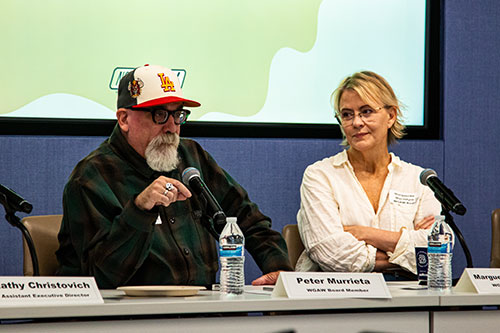 WGAW Secretary-Treasurer Peter Murrieta and WGAW Board member Marguerite MacIntyre at a recent free work clinic. Photo by Moises Marquez.
As part of its No Free Work initiative, the Guild is hosting a series of educational efforts structured around members’ rights under the MBA. Through clinics, the free work section of WGAW’s website, and sharing tools and stories on social media, the Guild is providing a space for members to share their experiences, as well as tools that writers can use to combat the practice in its many forms.
Concurrently, the Guild is conducting outreach to producers and agencies to inform them about the rules around payment for writing work and best practices for working with writers in a way that respects the writer’s time and contributions.
In addition to reporting instances of free work, writers are encouraged to share with the Guild and each other stories and techniques they have used to push back against requests for free work. The clinics have served as both information sessions and open forums. As Guild Secretary-Treasurer Peter Murrieta noted at a recent TV writer clinic, writer-to-writer communication can help build momentum.
“If everyone in here tells one other writer about what happened today and gets them interested—because they should be—we’re going to continue to build this campaign in a substantial way,” Murrieta said.
Stephanie Jackson, who is married to another screenwriter, says that she and her husband have both experienced different forms of requests for additional unpaid work. She took some comfort in hearing the experience of other writers and knowing that the Guild was taking steps to fight the practice.
 Screenwriter Stephanie Jackson. Photo by Courtney Lindberg Photography.
“I really liked hearing that there’s someone we can reach out to,” she said. “I plan to call and say, ‘This is the studio I was working with, this was my experience.’ I appreciate that during the panel they told us, if you talk to the Guild, we’re not going to take action without your permission.”
During the TV clinic, Sylvia Batey Alcalá shared that she has never written a “producer pass.” Her technique, she says, has been to tell producers that while their notes are likely in line with what the studio would request, she would prefer to stay on schedule to turn in the draft and address all notes in a later paid step.
“It’s saying ‘Not right now’ instead of no, and then I either address their notes or I don’t when I do the studio notes,” Alcalá said. “I feel like they’re mostly tinkering notes so they can feel justified in being there, and that’s not enough of a reason for me to delay delivery.”
Addressing a concern of potential retribution for refusing to work for free, Alcalá recounted an experience of enlisting the Guild to help her recover more than $10,000 in late pay. She later worked with the same studio and encountered no ill will.
“I didn’t believe that those creative execs had a whiff that I was paid late, much less that I grieved it,” Alcalá said.
Screenwriter Stan Chervin appreciated the discussion around the conundrum faced by writers, particularly those who are early in their careers, who believe that the more work they put in, the better the potential results.
 TV writer Sylvia Batey Alcalá.
“I had this mindset, and it’s pretty common among writers, that if I do what everybody asks, I won’t get fired, and if I do what they want, they’ll get a little more pregnant with it so they’ll have an investment in the movie and want it to move forward,” Chervin said. “None of which is true. It’s a kind of fallacy, and I’ve become a little more circumspect about that as I’ve gotten more experienced and older that it’s OK to say no to certain rewrites.”
In an effort to keep pitching and pre-greenlight development from becoming a free work trap, Tolli employs a number of practices that he has found to be successful. These include asking his reps to gather as much information as possible on a project to help gauge his potential time commitment before meeting with producers and limiting the number of pre-deal meetings he is willing to take.
“What I won’t do is numerous revisions before pitching to the studio,” Tolli said. “In TV, time is of the essence and mandates change quarterly. The longer we take tinkering, the less likely the studio will pursue. I’ve found setting expectations at the beginning of our partnership leads to more productive creative conversations and less nitpicky notes.”
Key Points
- A producer or employer shouldn’t ask for written material during a pitch without paying you, and they can’t record your pitch. Writers and their reps should say no to AI transcription during pitch meetings both in-person or on Zoom since that transcription is the same as leaving written material behind.
- If an employer asks for a written pitch document, that could qualify as a treatment (in screen) or a story or format (in TV) which the company would owe MBA payment for.
- Only writers—not producers, directors or studio executives—can determine when the draft is finished and ready for delivery.
- Only the person named in your contract is supposed to accept delivery of a draft. If producers, actors or other parties have notes, writers should ask that the notes be pooled to be addressed collectively during the next paid step.
- Writers should not start writing until they are commenced, and then commencement payment is due within seven days of commencement after which the writer is owed interest of 1.5% per month or at 18% per year. The Guild regularly submits batched late pay demands to studios.
- For deals as of January 1, 2027, all if/comes are non-exclusive and no position until a writer is paid for the first step.
Available resources include: the Guild’s Producers Guide to Working with Writers and the Screenwriters Handbook. Through the Start Button, writers can let the Guild know when work has begun on a step to help facilitate payment when the step is complete. Screenwriters can use the Invoice Tool to collect commencement payment or, if eligible, to bill for the next 25% of their fee.
Guild members looking to report violations can use the Free Work Reporting Form or speak to enforcement specialists Cathy Genovese (screen) or Chris Milliken (TV). These resources and additional information are listed in the Free Work Toolkit.
“I want writers to feel that they are not alone in this struggle,” said Board member Maggie Levin. “Free work is incredibly common, and we are collectively putting our foot down to make it a thing of the past.”
“The issue of free work is one that unites all Guild members at every stage of their careers and across all work areas,” added WGAW President Michele Mulroney. “Nobody is immune.”


