Eliana Pipes first learned about labor warrior Dolores Huerta not in school, but from her grandmother, Maggie, who started working alongside Huerta in the early days of the United Farmworkers movement, continuing for more than three decades. During the UFW’s 1,000 Mile March up the coast of California in 1975, the marchers rested overnight at her grandmother’s house.
A three-year member of the WGAW, Pipes recalls interviewing her grandmother for a 3rd grade family tree project about the importance of fighting for one’s beliefs.
“My grandmother was bilingual, and she grew up in El Paso,” Pipes said. “She was a white woman, but she had a real relationship to the injustices she witnessed on the border, and that really galvanized her towards a lifetime of activism. I grew up thinking activism is for girls. This is what my grandma does.”
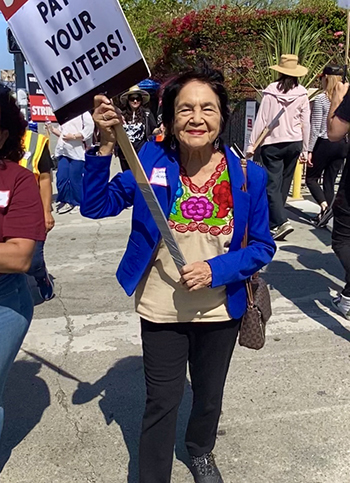 Delores Huerta walks the pickets line with writers on June 8, 2023.
It’s also what Eliana Pipes has done and continues to do.
While an undergraduate at Columbia University, she became involved in campus politics and activism and wrote a pilot about the Young Lords, the Black and Puerto Rican civil rights organization that evolved from a street gang into a political force in Chicago and New York. The subject was a natural for Pipes, a writer of Black, white and Puerto Rican heritage and a self-described “revolution nerd.”
In the early years of her career as a writer and filmmaker, Pipes earned the Academy of Motion Picture Arts and Sciences’ Academy Gold Fellowship for Women as well as the inaugural WAVE Grant through Wavelength Productions, and the inaugural Outfest x Colin Higgins Foundation Youth Filmmaker Award. The Young Lords script helped gain her entrance into the Guild when showrunner Steven S. DeKnight read it and staffed her for the first two seasons of Spartacus: House of Ashur.
“He chose me based on the Young Lords script, which was a historical action drama,” Pipes said. “He figured, ‘She can do ancient Rome’ which was wonderful.”
But even as her TV and film career was progressing, Pipes was not done with Dolores Huerta. Center Theatre Group (CTG), which had tracked Pipes’s career as a playwright, commissioned her to write Si Se Puede!, a one-act play about Huerta’s role in the founding of the United Farmworkers. As the play launches the second leg of its tour to schools and community centers across L.A. on October 24, Pipes reflected on the importance of continuing the fight to build worker power.
“I think the more I study revolutions, the more I value the ongoing process of being engaged with other people and with the process of building collective power rather than hoping for a perfect outcome,” Pipes said. “There’s a line in my play: ‘It’s about progress not perfection.’ I try to hold that close. I really wish we could have perfection, but I’ll take progress for now.”
“It’s astonishing to think about how truly impossible people thought it was to organize the farmworkers,” she added. “The bravery and the dedication it takes for someone to decide to do the impossible is something we feel a lot as writers and as artists. It sure feels impossible sometimes but we do it because we care and we know in our heart it’s important.”
Produced under the CTG Forward educational initiative, Si Se Puede! visited a number of schools, libraries and community centers in Culver City, Boyle Heights and Pasadena in the spring. The play was so popular that CTG programmed a new round of tour stops for the fall covering different regions of LA and Orange County.
“We went to Boys and Girls Club, libraries, rec centers…you name it, we did it and we’re still doing it,” said Jesus Reyes, CTG’s Director of Learning & Community Partnerships.

The bravery and the dedication it takes for someone to decide to do the impossible is something we feel a lot as writers and as artists.
- Eliana Pipes
Part of the draw of Si Se Puede! has been the renown of Huerta herself. Reyes reports that, while she has not yet seen the play, Huerta and representatives from her foundation know it exists and she would receive an enthusiastic welcome if she were to turn up at a performance.
“She’s constantly moving, even at the age of 97, she’s constantly showing up to rallies, to events to promote women’s rights and people’s rights,” Reyes said. “She’s got work to do, and we need her to continue to do the work. We didn’t write this play for her to show up. I guess you could say we wrote it for the places she can’t be. We’ll be there and we’ll represent her.”
Tasked with condensing 40 years of history into an all-ages drama that can fit into a school period, Pipes drew from the stylized tradition of Luis Valdez’s El Teatro Campesino (The Farmworkers Theatre), which, during its early years, staged plays on the back of flatbed trucks. “That was partially so they could reach workers on the picket lines,” Pipes said, “but also so they could drive away if the cops came.”
Pipes included El Teatro Campesino tropes like having the greedy growers dressed in pig masks and putting devil horn masks on the politicians. She included scenes inspired by her grandmother and father, both of whom are named in the play.
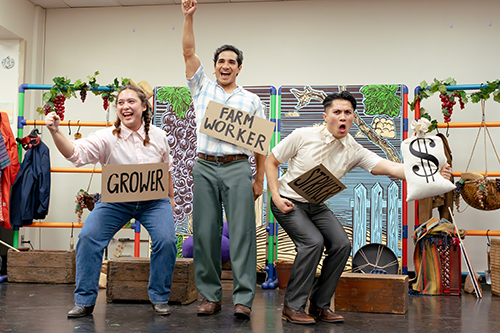 Sol Joun, Juan De La Cruz, and Brandon English in the play Si Se Puede. Photo by Javier Vasquez/CTG.
Fellow UFW leaders Cesar Chavez and Filipino American union organizer Larry Itliong also appear in the play. Si Se Puede! was at the end of its tech rehearsals last spring when reports surfaced of widespread sexual abuse by Chavez against UFW members including Huerta. The allegations prompted Pipes and director Sara Guerrero to make some revisions on the fly.
“Then we had our first invited dress rehearsal with students from East Los Angeles College,” recalled Pipes. “It was a lot of tears and there was just a moment at the end where all the women of the play kind of came together. It felt really great to have the play be a sort of a communal space where people could process that news and also move forward from it. There were a lot of people who seemed to really be grateful to have that space to think about the women in this movement that had so often been overlooked.”
Although the play does not address the sexual assualt allegations, Si Se Puede! does touch on the challenges that women faced as leaders even within their own movements. While stories about female activists often emphasize the barriers they were able to overcome, Pipes notes that the Farm Worker unionization effort was successful in part because of the ability to enlist women and children.
“The boycotts, which were such a huge part of the success of this movement, were spearheaded by women who were doing the grocery shopping,” Pipes said. “Women have always been at the vanguard of social change, and centering Dolores and all the women who are involved in the story was really important to me. My grandmother was one of them.”
Eliana Pipes had her own experience on the picket lines in 2023 during the WGA and SAG-AFTRA strikes. She learned that she had landed the staffing job on Spartacus: House of Ashur three days before the writers’ strike was called and, with pencils down, spent the next five months wondering whether she would still have a writers’ room waiting for her at the end.
All ended well, as she discovered that her staff writer job would be improved by the provisions of the 2023 MBA including earning a script fee for her episode which, she said, “absolutely changed the world for me financially.”
“I really feel so grateful to have benefitted from the gains that were made in that strike,” she said. “I’m a very proud WGAW member, and I’m thrilled to belong to the union.”