When was the last time you saw caregiving and the challenges facing people caring for loved ones on screen? What was the most memorable depiction?
On the big screen, perhaps it was Everything Everywhere All at Once (2022), where main character Evelyn Wang’s stress about caring for her aging father, running a business audited by the IRS, and dealing with a kind but hapless husband kicked her into an absurdist multiverse. Or maybe it was American Fiction (2023), where Monk Ellison’s drive for funds to pay for his mother’s expensive assisted living care spurred him to write an absurd yet wildly popular novel under a pen name.
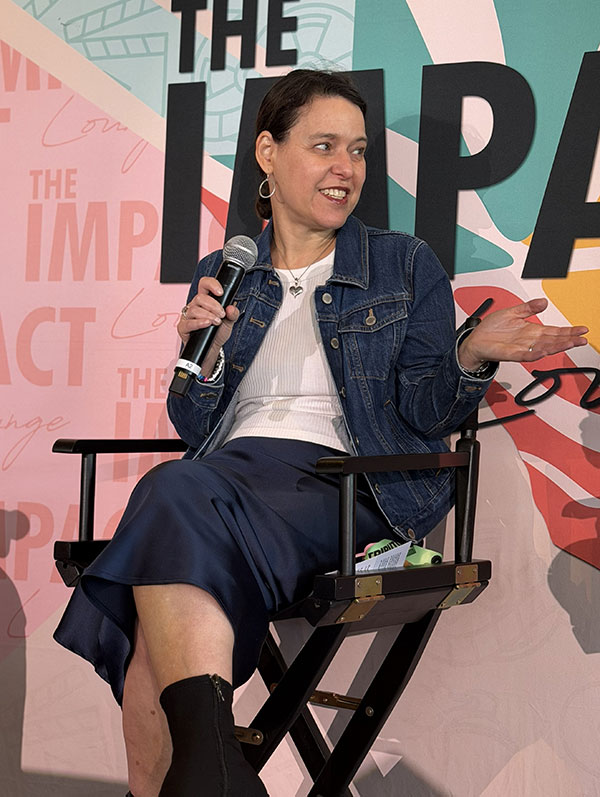 Vicki Shabo, founder and director of the Re-Scripting Gender, Work, Family, and Care entertainment initiative and senior fellow at New America.
On television, where shows have more time to explore relationships and character dynamics, perhaps it was This Is Us, a popular show with real-world impact on viewers’ perceptions of caregiving that centered multiple care stories about aging, disability, and work-parenting challenges over its six seasons, or, more recently, The Pitt, where a caregiving storyline in the show’s first season showed caregiver burnout and named publicly-funded respite services for caregivers as a solution. Or maybe it’s something where care is present but less deeply explored: Bode managing care decisions for his grandfather Walter on Fire Country, Abbott Elementary’s Ava’s mysterious mid-year “vacation” revealed as time she needed to care for her grandmother’s dementia, or Oswald dancing with his mother on The Penguin.
It’s exciting to be able to name these examples, and yet they are exceptions. Unfortunately, on screen, caregiving and the circumstances surrounding it are rarely shown woven into characters’ lives as they are into our own. In a nationally representative survey of 1,310 U.S. TV and film viewers in 2025, conducted for New America’s Re-Scripting, Gender, Work, Family, and Care initiative by the media research firm MarketCast, only four in 10 viewers said they “often see” shows or films that include characters caring for loved ones with mental health conditions, or loved ones who are disabled or aging, and fewer than three in 10 said they “often see” characters taking time away from work to manage care for themselves and others.
Viewers perceptions are backed up by an analysis of television content: The Geena Davis Institute and Caring Across Generations found that fewer than 11 percent of 608 television shows in a 2021 sample included storylines depicting caregiving; and depictions of the relationship between caregiving or parenting and work, personal responsibilities, or finances were very rare. Moreover, fewer than .01% of episodes included policy or workplace policy solutions.
Anecdotally, we’ve noticed another characteristic of stories featuring a work, family, or caregiving circumstance. When a caregiving challenge or a work-family conflict does appear, it is often a catalyst for the story’s main action or a character’s central challenge, but the story goes on to resolve that main conflict without addressing, improving, or resolving the character’s care-related circumstance. How many of us can name a show or film where an aging mother of a main character, who has previously been hospitalized in service to some other story goal, recovers but is never heard from again?

Viewers want to see more depictions of work, family, and care on screen—and data and experience suggests that their loyalty to shows, characters, and subscription services will follow.
- Vicki Shabo
Unlike television or film characters, people in the United States cannot selectively attend to a loved one’s needs, nor can they lose the care plot entirely. They can’t miss work without consequences, or have an uninterrupted coffee in the middle of the day with their friends when an older loved one relies on them for care. For an estimated 130 million Americans who are caregivers to an older adult, a disabled adult or child, or are parents of a minor child, attention to care is a constant.
The invisibility of care on screen contributes to common cultural narratives and expectations: Care is private. Finding and managing care is just something we have to do. Costs are high, but that’s just the way it is. Care is something women are naturally more skilled at than men. Negotiating and receiving workplace accommodations is a sign of capability or good luck.
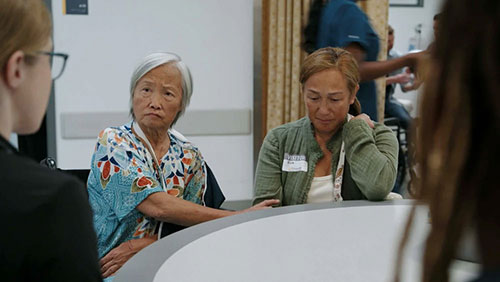 In season 1 of The Pitt, a memorable storyline depicted how the challenges of caregiving can lead to burnout.
Recent research from my New America colleagues has shown that lack of cultural conversation contributes to widespread lack of awareness—about how much families pay for child and elder care, how little care workers are paid, and how little the U.S. government contributes to offsetting the costs of care and to systems of care. The absence of caregiving and parenting considerations onscreen also keeps millions of us who are facing stressful, isolating, and overwhelming circumstances feeling that we are alone—and it keeps people who could be allies and advocates for workplace and policy changes in the dark about what others are going through and the kinds of help and support that would be useful.
Viewers want to see more depictions of work, family, and care on screen—and data and experience suggests that their loyalty to shows, characters, and subscription services will follow. In our 2025 research, 92 percent of viewers say stories embedding work and family into shows and films as they are woven into people’s lives is important; 79 percent said this makes characters more relatable and easier to connect with. A full 63 percent want to see more shows and films where households include family members with a disability or chronic health condition. Nearly two-thirds of viewers said that seeing more representation of work, family, and care on screen would affect their likelihood of subscribing or staying subscribed to a streaming service.
Analysis of online conversations in both 2024 and 2025 showed that content that doubles down on work, family, and caregiving content generates more conversation and recommendations to watch.
New qualitative and quantitative research conducted this summer and fall, which we will release soon, gives us more depth and texture about what audiences want and what authenticity means. Viewers want to see characters managing work, family, and care in all types of media portrayals, whether in genre shows like Black Mirror and Severance, procedurals like Law and Order and High Potential, or comedies like Modern Family and St. Denis Medical.
What’s most important is consistency and realism in how caregiving and the circumstances surrounding it with respect to work, family, finances, and health are portrayed. Finally, viewers also want to see solutions that go beyond the individual hero narrative to explore the communities, systems, and supportive policies that could help.
For writers interested in real world impact, there are fruitful storytelling avenues to pursue in every genre, format, and storyworld. Commit to evaluating your most recent script with a new eye, talk to people with lived experience providing or receiving the specific kind of care that is part of your story, and look for holes to fill that make your characters more human, more relatable, and more engaging. And know that, as a result of your vision and craft, you’ll help shift culture and policy.
New America’s Resources for Caregiver Storylines
The Re-Scripting Gender, Work, Family, and Care Initiative at New America has created a library of tip sheets and resources for creatives. It includes: data-driven guides about jobs, money, and work-family stress; breaking down gender stereotypes; and writing about child care; writing about working parents, and more, with more resources planned in 2027. Resources from partner organizations in media and policy provide rich sources of data and stories.
The StoryCare5, a tool created earlier this year with partners at the public benefit entertainment company, Level Forward, can also help. It poses a series of questions writers can use to consider angles around job circumstances, family relationships, care responsibilities, and personal circumstances in their scripts. The fifth consideration of the “5” is possibilities—whether there are actions your character can reasonably take to affect what’s available to support them and others in their community, workplace, or through government policies, and what difference the availability of supports would or can make. Our tip sheet on work-family storytelling and civic engagement provides more specific examples. The Care Inclusion Playbook, created by Caring Across Generations, is also a great tool for storytellers.
On-screen storytelling is all about taking viewers on a journey, and using imagination to imagine other worlds. What if those worlds included care more visibly, and helped the 130 million people navigating care and parenting—and all of us, including policymakers—see the value of different interventions in crafting a new reality?
Vicki Shabo is the founder and director of the Re-Scripting Gender, Work, Family, and Care entertainment initiative, which seeks more authentic and inclusive representation of common challenges facing working people and families on screen. She does this work as a senior fellow at New America, a nonprofit, nonpartisan think tank. She is also a policy expert, strategist, and advocate whose work has contributed to winning paid family and medical leave, paid sick time, and other policies affecting tens of millions of working families across the United States. Follow the initiative’s work on Instagram at @rescriptingworkandfamily.

