

Takeaways from the MENAWC Committee’s panel on how to pitch, adapt, and navigate the world of intellectual property.
10/16/2026 • Evan Henerson
A “Revolution Nerd” Honors Dolores Huerta
Guild member Eliana Pipes pays tribute to a labor legend.

Takeaways from the MENAWC Committee’s panel on how to pitch, adapt, and navigate the world of intellectual property.
On a recent September evening, the Middle Eastern and North African Writers Committee (MENAWC) held a panel about pitching, adapting, and generally navigating intellectual property (IP).
Committee Co-chairs Ursula Taherian and Sahar Jahani introduced Dan Hernandez and Benji Samit, the writing/producing team behind Teenage Mutant Ninja Turtles: Mutant Mayhem, Pokémon Detective Pikachu, Lego Star Wars: Rebuild the Galaxy, and the upcoming Spaceballs: The New One.
The duo started out writing original work, and in 2012 were staffed on 1600 Penn. Samit pointed out that being on staff was a lot like writing IP. “You’re writing characters that aren’t necessarily yours, and getting practice taking something that exists and doing your own thing with it but still being true to the material.”
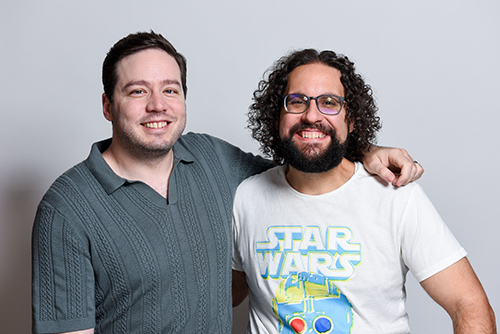
He added, “Dan’s first IP writing was X-Files fan fic.” Said Hernandez, “It was a really good way to practice, and to learn other characters and read other fan fictions of people that were more experienced, better writers.”
Moderator Audrey Wauchope (Crazy Ex-Girlfriend) said the first script she wrote was an adaptation of Jane Austen’s novel Persuasion, “because public domain is free IP. I always tell people, dabble in public domain to practice if you want.”
Hernandez seconded the idea, noting that IP isn’t new. “Sherlock Holmes is IP. It’s been adapted since the 1800s as stage plays, as silent movies.”
They staffed on Super Fun Night and One Day at a Time, and joined the animated series The Tick, to get closer to their preferred genre. “We want to write superheroes, we want to write big movies, we want to write IP, we want to play with the toys,” Hernandez said. “We felt if we get this credit it might begin to change the narrative of how people perceived us in the business.”
Their first IP pitch was on a movie of Gilligan’s Island—and they got it.
But not without hearing the wildest notes they could imagine, Hernandez said. “The executive was like, ‘Boys, I love it. Two tiny notes. Microscopic notes. First note, this guy Gilligan seems like a fucking idiot. Why is this guy so dumb? He’s such a bad sailor. Do we need Gilligan? And two, do we need the island?’ This was real.”
The movie wasn’t made, but they were undeterred.
Another important tip: executives become wary if you’re too much of a fan. “We know people who go in with such a clear vision, but for whatever reason it’s out of alignment with what is possible, and those situations always end really badly,” Hernandez said.
“We approach this stuff as fans,” Samit said. “We try to only adapt stuff that we genuinely like. So we are gonna be respectful to fans to a certain extent. But at the same time, you can’t necessarily be beholden to what the people on Reddit are saying they want it to be, because a lot of times what makes for a great adaptation is something surprising.”
Another writers’ room lesson: Don’t be precious. Hernandez added, “As a writer of IP you need to take all of the input from the rights holder, from the executive, from the director, sometimes from the visual effects person, and then you have to be the arbiter of what’s going to make the best adaptation. Sometimes you’re right, and sometimes there’s something you really love and for reasons completely unrelated to the idea they say, ‘We can’t do this because next year there’s a new toy line coming out, and we can’t step on that.’”

Anytime we’re trying to figure out a pitch, a movie, or show, there’s an initial question of, what is this actually about?
- Benji Samit
Hernandez and Samit’s first produced IP was Pokémon: Detective Pikachu. “That was the before and after,” Samit said. “All you need is one,” Hernandez added.
Wauchope asked, particularly of those early bake-off years, “Do you guys have something that you feel is important in the pitch that books you the job?”
“This is true for both IP and original: Anytime we’re trying to figure out a pitch, a movie, or show, there’s an initial question of, what is this actually about?” said Samit. “What’s the core way in?”
The Teenage Mutant Ninja Turtles IP had seen several adaptations, but none had ever emphasized the teenage aspect. So they came up with a coming-of-age tale. “Once we all grasped onto that idea, it became a lot easier to build an entire movie,” Samit said. “You have this theme and this feel you’re going for.”
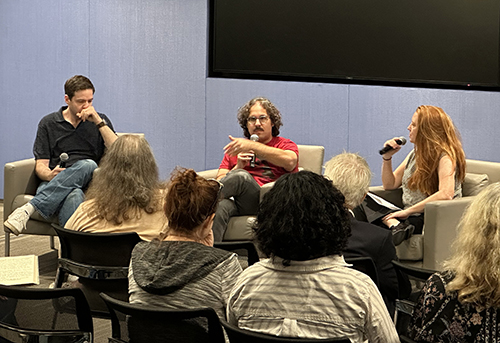
The duo warned against pitching on IP that has been on the writing assignment grid for a long time. It doesn’t cost the executive anything to hear a pitch, but it likely won’t go anywhere. Writers should also be wary of the free work traps associated with “bake-offs,” in which multiple writers compete for the same assignment.
Before investing your time on a project, use the WGAW’s Project Page to gather key information, including how many other writers are competing, whether the IP rights have been secured, and what other talent is attached.
That said, if an IP you love is locked up, check on it every now and then. They were interested in an unavailable project for five years, and finally the option lapsed. They developed it for a TV show.
Wauchope noted that IP often gets a bad rap, unfairly. “Is there a lot of crappy IP stuff? Yes,” said Samit. “There are also a lot of crappy movies of all types.” Studios spend so much money on IP, “they’re going to make it whether it’s good or not. Where we come in is we try to make sure that it’s good. Not everyone involved cares.”
“Often there’s a moment where I’m writing IP where I go, Am I just writing a commercial?” Hernandez said. “Sometimes the answer is yes. If you can work that within the process, and say, I understand that LEGO’s agenda is different than my artistic agenda, but that doesn’t mean that I can’t make this artistically meaningful and emotionally meaningful and hopefully, in the case of Lego Star Wars, something that any Star Wars fan or LEGO fan can get something out of it.”
An attendee asked how they deal with bad notes that could be reversed at the next level.
“Look, it sucks getting bad notes, whether human or computer,” said Samit. But if similar notes are coming from multiple people, something isn’t connecting the way it should, and they tackle that.
And sometimes execs aren’t reading the material closely, he added. “So we may or may not, on some rewrites, simply add stars on a page without changing a single word, to say, ‘Look right here!’”
Hernandez said, “Learn to use the phrase, ‘We’ll definitely take a look at that.’ But if you use the phrase, you’ve gotta mean it.”
Samit expressed compassion for execs. “As bad as it is for writers, in many ways it’s just as bad for executives out there, and so they’re terrified and they’re over-noting and they’re afraid of making their boss angry.”
After the panel wrapped, the MENAWC co-chairs were enthusiastic about the panelists’ perspectives. One tip particularly resonated with Taherian, “that anyone who’s been in a writers’ room has essentially already adapted IP. That blew my mind; I’d never thought of it that way.”
“That kind of transparency between writers is especially important because so much about this business can feel elusive,” said Jahani. “For underrepresented writers, including MENA writers who make up less than one percent of the Guild, access to that knowledge and those relationships can be even harder to come by.”